These Days Before the Vote: "We must guard against the acquisition of unwarranted influence . . . by the military-industrial complex."
Whitewater, Wis. — Today’s entry this gray Friday morning continues These Days Before the Vote, a series addressing each day before the November election a principle or position on which our liberal democratic tradition rests.
In his 1961 Farewell Radio and Television Address, Pres. Dwight Eisenhower warned that
This conjunction of an immense military establishment and a large arms industry is new in the American experience. The total influence - economic, political, even spiritual - is felt in every city, every state house, every office of the Federal government. We recognize the imperative need for this development. Yet we must not fail to comprehend its grave implications. Our toil, resources and livelihood are all involved; so is the very structure of our society.
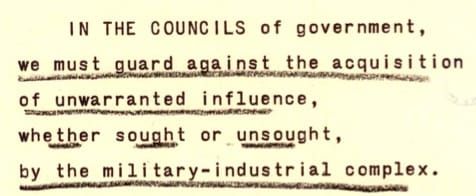
In the councils of government, we must guard against the acquisition of unwarranted influence, whether sought or unsought, by the military-industrial complex. The potential for the disastrous rise of misplaced power exists and will persist.
We must never let the weight of this combination endanger our liberties or democratic processes. We should take nothing for granted. Only an alert and knowledgeable citizenry can compel the proper meshing of the huge industrial and military machinery of defense with our peaceful methods and goals, so that security and liberty may prosper together.
See Dwight D. Eisenhower, Farewell Radio and Television Address to the American People, National Archives (Jan. 17, 1961). Eisenhower is oft-quoted for these remarks about the military-industrial complex, but also quoted too narrowly. His warning was expressly and plainly about threats to "our liberties or democratic processes."
In the middle of the Cold War, when others might have insisted on closer ties between industry, the military, and civilian political authority, Eisenhower wisely and presciently warned against that approach. We are a republic under civilian authority, to which military power is subordinate, and upon which industrial power must not encroach.
Trump, by contrast, imagines American cities as military targets to be conquered. On September 30, 2025, Trump told senior military leaders that “we should use some of these dangerous cities as training grounds for our military.” He told that same audience that conditions in American cities would be “a war from within” and “a major part for some of the people in this room.” See Donald J. Trump, Remarks to the Department of War in Quantico, Virginia, Govinfo.gov (Sept. 30, 2025).
Nearly three weeks later, when responding to concerns about his preference for military action against civilian opposition, Trump falsely declared that he could invoke the Insurrection Act and described his desired result: “And there’s no more court cases. There’s no more anything.” He called it “the strongest power a President has.” See Donald J. Trump, Remarks in an Exchange with Reporters Aboard Air Force One En Route to Joint Base Andrews, Maryland, Govinfo.gov (Oct. 19, 2025).
Trump — not for the first time — is mistaken about what his reliance on military action would mean. Trump repeatedly speaks as if directed military force could settle disputes bypassing ordinary legal resistance. His use of the military on supposed training grounds against peaceful & lawful political dissent would not be the strongest actions of an American president — it would be an initial action of an American tyrant.