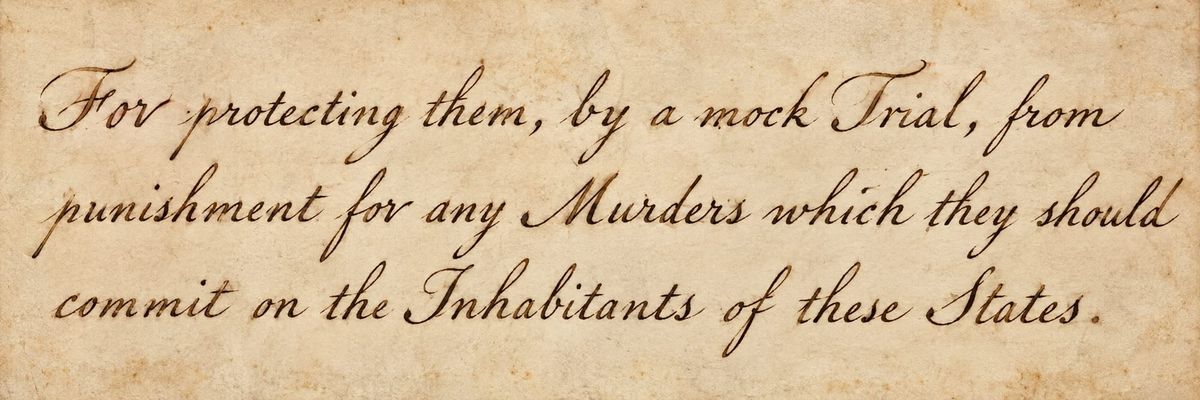
These Days Before the Vote: "For protecting them, by a mock Trial, from punishment for any Murders which they should commit on the Inhabitants of these States."
Whitewater, Wis. — Today’s entry this Monday evening continues These Days Before the Vote, a series addressing each day before the November election a principle or position on which our liberal democratic tradition rests.
Consider the Declaration’s charge against the British monarch: “For protecting them, by a mock Trial, from punishment for any Murders which they should commit on the Inhabitants of these States.” Britain's Administration of Justice Act of 1774 permitted the royal governor, with council consent, to move specific murder prosecutions from Massachusetts to another colony or even Great Britain if "an indifferent [impartial] trial" could not be had within Massachusetts. See Administration of Justice Act 1774, 14 Geo. 3 c. 39, §§ I–II (Gr. Brit.). Impartiality in these trials was a matter of British, not American, definition ("to the satisfaction of the said [royal] governor, or [royal] lieutenant-governor respectively").
In this way, the British government under the authority of George III, King of Great Britain, France, and Ireland, would dispense supposed justice through trials far removed from the people of Massachusetts.
Two hundred fifty-one years later, an American government under Donald J. Trump, President of the United States — not through a faraway mock trial but through a nearby perversion of justice — gave a pardon to convicted murderer Terence Sutton. A jury found that Sutton, a police officer, caused the death of 20-year-old Karon Hylton-Brown in a pursuit that continued through neighborhood streets at unreasonable speeds. Sutton then followed Hylton-Brown into an alley, extinguished his emergency lights and siren, and accelerated. The pursuit was intentional, as was the attempted concealment of it afterward:
Neither Sutton, as the lead officer at the scene, nor Zabavsky, the ranking MPD official, preserved the crash scene for investigators; they allowed the driver of the car that struck Hylton-Brown to leave the scene within 20 minutes of the crash. They then turned off their own body worn cameras, conferred privately, and left. Zabavsky designated no other MPD official to supervise the scene upon his own departure. Sutton further compromised the integrity of the crash scene by driving his MPD car directly over the crash site, audibly crushing pieces of debris from the collision as he left. At no point did either defendant contact MPD’s Major Crash Unit (MCU) or its Internal Affairs Division (IAD) to initiate an investigation by those units.
Sutton and Zabavsky continued the cover up back at the police station. First, they misled their commanding officer about the nature of the incident by substantially downplaying its seriousness, denying that a police chase had even occurred, and omitting any mention of Mr. Hylton-Brown’s critical injuries. Zabavsky also falsely implied that Mr. Hylton-Brown had been a drunk driver. Both defendants also hid their direct involvement in the incident, thereby avoiding the assignment of other, uninvolved MPD officials to investigate what had happened. Sutton drafted a police report that memorialized a false narrative of the incident. Despite video evidence to the contrary, his false narrative gave the impression that no police pursuit had occurred, that officers had lost sight of Mr. Hylton-Brown and were engaged in a “canvass” of him in the area until shortly before the crash, and that the officers were wholly uninvolved with the fatal collision in any way. The defendant’s account also described Mr. Hylton Brown’s observable injuries only as “superficial abrasions on [his] left eyebrow line.”
See U.S. Att’y’s Off. for D.C., Two MPD Officers Sentenced for 2020 Murder of Karon Hylton-Brown and Subsequent Coverup (Sept. 12, 2024).
Hylton-Brown, suffering from severe head trauma, died on Oct. 25, 2020.
Sutton received a nine-week trial, after which a unanimous jury convicted him on December 21, 2022, of second-degree murder, conspiracy to obstruct, and obstruction of justice. (Zabavsky was convicted of conspiracy and obstruction, not murder.) On September 12, 2024, Sutton received a 66-month prison sentence and Zabavsky a 48-month sentence.
An American judge, an American jury: a fair trial and a considered sentence. Where the British Crown would have effected an injustice by removing a trial from our shores, Trump effected a more immediate injustice by disregarding a trial on these shores. In this, Trump and the defendants he pardoned are united: they were unworthy of receiving a pardon, and Trump was unworthy of conferring one.