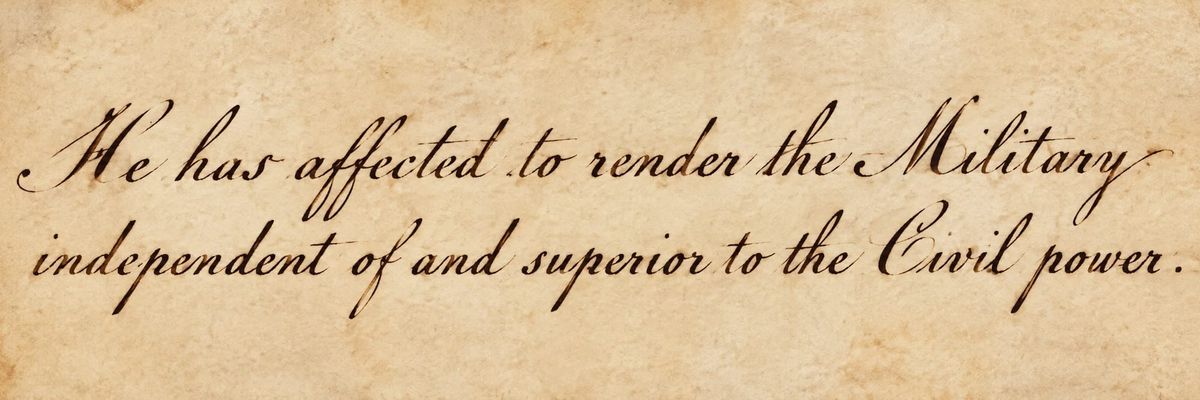
These Days Before the Vote: "He has affected to render the Military independent of and superior to the Civil power."
Whitewater, Wis. — Today’s entry this Sunday evening continues These Days Before the Vote, a series addressing each day before the November election a principle or position on which our liberal democratic tradition rests.
Consider the Declaration’s charge against the British monarch: “He has affected to render the Military independent of and superior to the Civil power.” Trump, having spent a lifetime as a tin soldier and armchair general, has never understood that civilian control involves more than having a civilian commander in chief. Our Constitution gives the president military command, but gives Congress authority to raise and support armies, regulate the armed forces, and provide for calling forth the militia. Presidential command exists only within a system of legislative authority and judicial review. A civilian president’s order does not, and cannot by itself, establish that a military action is lawful. See U.S. Const. art. I, § 8, cls. 12–16; art. II, § 2, cl. 1.
Nearly seventy-five years ago, in Youngstown, the U.S. Supreme Court rejected President Truman’s assertion that his power as commander-in-chief allowed the federal government to seize over steel mills during the Korean War. See Youngstown Sheet & Tube Co. v. Sawyer, 343 U.S. 579, 585–89 (1952).
Along these lines, the Posse Comitatus Act generally prohibits using federal armed forces to execute domestic laws unless the Constitution or an act of Congress expressly authorizes it. See Posse Comitatus Act, 18 U.S.C. § 1385.
And yet, and yet, despite these venerable principles, on June 7, 2025, Trump issued a presidential memorandum asserting that immigration protests amount to a kind of rebellion. Invoking 10 U.S.C. § 12406, he ordered at least 2,000 National Guard personnel into federal service for 60 days, subject to the defense secretary’s discretion. Their purported mission was to protect federal personnel and property during protests. See Donald J. Trump, Department of Defense Security for the Protection of Department of Homeland Security Functions, White House (June 7, 2025). By June 13, the Pentagon had deployed nearly 4,700 personnel supporting Trump's order.
California Governor Gavin Newsom opposed the federal takeover and filed suit against it on June 9. See Off. of Governor Gavin Newsom, Governor Newsom Suing President Trump and Department of Defense for Illegal Takeover of CalGuard Unit (June 9, 2025).
Nearly three months later, after a trial in August, U.S. District Judge Charles Breyer ruled on September 2 that the administration’s use of troops for civilian enforcement violated the Posse Comitatus Act. See Newsom v. Trump, No. 3:25-cv-04870-CRB, slip op. (N.D. Cal. Sept. 2, 2025). (The Ninth Circuit administratively stayed that order on September 4, expressly without deciding the appeal’s merits.)
On December 10, the district court issued a separate order directing the government to return control of the California National Guard to Governor Newsom. The Ninth Circuit temporarily stayed that portion of the order. After the U.S. Supreme Court’s December 23 decision concerning Illinois (Trump v. Illinois, No. 25A443, slip op. at 2–3 (U.S. Dec. 23, 2025)), the Ninth Circuit required the government to explain why a partial stay should remain. The Trump administration withdrew its request for a stay pending appeal and did not oppose lifting the temporary stay. On December 31, the Ninth Circuit lifted the stay, allowing the directive returning the Guard to California’s control to take effect. See Newsom v. Trump, No. 25-7781, order at 1–2 (9th Cir. Dec. 31, 2025).
Using troops to perform civilian policing subjects civilian law enforcement to military coercion. These months of litigation succeeded only in preventing further harm. An administration that respected civilian authority would not have inflicted these harms in the first place.