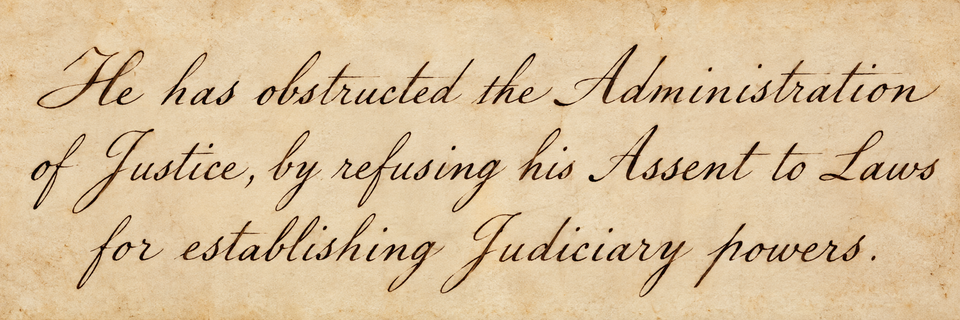
These Days Before the Vote: "In every stage of these Oppressions We have Petitioned for Redress in the most humble terms: Our repeated Petitions have been answered only by repeated injury."

Whitewater, Wis. — Today’s entry this Thursday evening continues These Days Before the Vote, a series addressing each day before the November election a principle or position on which our liberal democratic tradition rests.
Consider the Declaration’s charge against the British monarch: “In every stage of these Oppressions We have Petitioned for Redress in the most humble terms: Our repeated Petitions have been answered only by repeated injury.” Our break with Britain came after colonists' grievances to be heard and considered were ignored; the colonists were met only with new and further reasons to be aggrieved. In July 1775, the Second Continental Congress sent an Olive Branch Petition to Britain. The Congress sought reconciliation, but George III refused — formally — to receive or answer it. Yet by August 23rd, that King of Great Britain, France, and Ireland, and Defender of the Faith (headed as 'By the King') answered the colonies' petition only by escalation of violence in a proclamation declaring the colonies in rebellion.
Our First Amendment — ours, won after a Revolution and later adoption of the Constitution and amendments to it now governing federal conduct — allows for the petition of grievances without retaliation for those very petitions. In Smith v. Ark. State Highway Emps., Local 1315, 441 U.S. 463, 464–65 (1979) (per curiam), the Court distinguished the government’s discretion to disregard a petition from retaliation against someone for petitioning ("he [the petitioner] is protected by the First Amendment from retaliation for doing so.").
Earlier this year, on 1.12.2026, Minnesota, Minneapolis, and Saint Paul sued to challenge Operation Metro Surge. The very next day, Trump publicly threatened “RETRIBUTION” (“FEAR NOT, GREAT PEOPLE OF MINNESOTA, THE DAY OF RECKONING & RETRIBUTION IS COMING!”). On 1.20.2026, DOJ served grand-jury subpoenas on six state and local government offices. Minnesota’s attorney general rightly characterized the investigation as retaliation for opposing the administration’s immigration operations.
Minnesota Chief Judge Patrick Schiltz quashed all six subpoenas in an order dated 6.17.2026 and unsealed on 6.22.2026. The court addressed "the moving parties' contention that the subpoenas were issued as part of an unconstitutional effort to coerce Minnesota officials into assisting the federal government with enforcing civil immigration laws and to harass and retaliate against them for failing to do so. The Court agrees with the moving parties." (The court grounded the finding of retaliation in this case in the Tenth Amendment; the traditional prohibition against retaliation being found in more than one part of the Constitution.)
With George III and with Donald J. Trump, the same imperious, autocratic tendency emerges: lawful petitions for redress met only with threats of escalation.