These Days Before the Vote: "The third is freedom from want..."
Whitewater, Wis. — This Wednesday evening in Wisconsin continues These Days Before the Vote, a series addressing, each day before the November election, a principle or position on which our liberal democratic tradition rests.
In his January 6, 1941, address to Congress, Roosevelt then offered a third freedom as a goal:
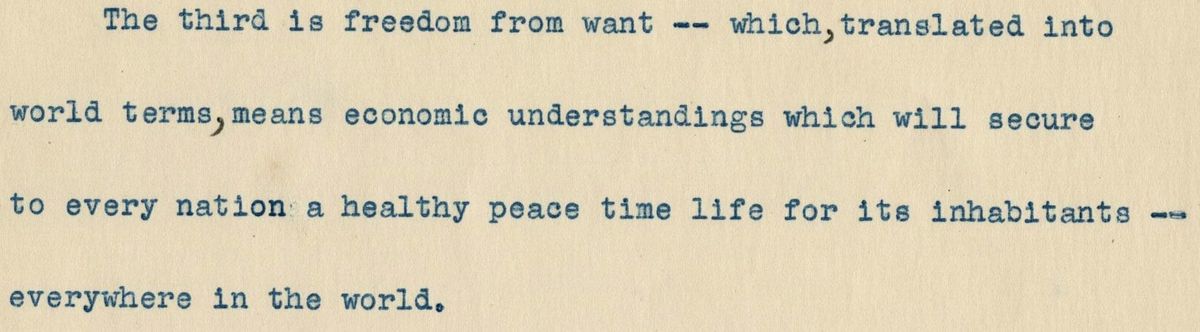
The third is freedom from want – which, translated into world terms, means economic understandings which will secure to every nation a healthy peacetime life for its inhabitants – everywhere in the world.
See Franklin D. Roosevelt, Annual Message to Congress on the State of the Union (Jan. 6, 1941), Nat’l Archives.
Nearly ninety years later, Trump has weakened — severely weakened — peaceful and profitable global trade. Tariffs have reduced trade. The World Trade Organization forecasts 2026 merchandise trade growth dropping from 2.5% to 1.8%. See Frontloading, Measured Responses Cushion Tariff Impact in 2025 but Risk High for 2026, World Trade Org., August 8, 2025. America and the developed world now finds themselves far removed from the reliable international arrangements Roosevelt had in mind. Tariff uncertainty weighs on business confidence, investment, and supply chains.
America's withdrawal from development aid has reduced poorer nations’ resources. See A Historic Decline in Foreign Aid: Preliminary 2025 ODA Data, Org. for Econ. Coop. & Dev., April 9, 2026 ("The United States alone drove three-quarters of the decline, with its ODA falling by 56.9% compared to 2024.").
The Iran War, ill-justified and ill-planned, has shaken global energy markets. March 2026 brought the largest oil-supply disruption in history, with global supply falling by 10.1 million barrels a day and oil prices recording their largest monthly gain:
Global observed oil inventories fell by 85 mb in March, with stocks outside of the Middle East Gulf drawn down by a significant 205 mb (-6.6 mb/d) as flows through the Strait of Hormuz were choked off. At the same time, with limited outlets after the effective closure of the Strait, floating storage of crude and oil products in the Middle East rose by 100 mb and onshore crude stocks in the region were up by 20 mb. China added 40 mb of crude to tanks.
See Oil Market Report—April 2026, Int’l Energy Agency, April 14, 2026.
That same war also threatens the global food supply:
The burden will fall most heavily on the world’s most vulnerable populations, particularly in low‑income, import‑dependent economies. Spikes in fuel prices and potential sharp increases in food prices are especially concerning where fiscal space is constrained and debt burdens are already high, reducing governments’ ability to protect vulnerable households.
See Joint Statement by the Heads of the International Monetary Fund, the World Bank Group and the World Food Programme, Int’l Monetary Fund, World Bank Grp. & World Food Programme, April 8, 2026.
Here in Wisconsin, an agricultural and manufacturing state that depends on diesel, the effect has been severe:
Diesel prices in Wisconsin have hit record highs as the war in Iran continues to disrupt the flow of the fuel globally.
In Wisconsin, the average price per gallon of diesel fuel on Wednesday was $6.13. Last year, the average in the state was $3.45 per gallon, according to data from the American Automobile Association.
Mike Semmann, president of the Wisconsin Grocers Association, said the price of diesel will have an impact on many different parts of the grocery supply chain.
“Diesel is to the economy what electricity is to a home,” he said. “For Wisconsin consumers, it’s not just about what diesel costs, but about how businesses across the state are really trying to work to keep those costs from becoming a burden on Wisconsin families.”
He said diesel costs affect every part of the supply chain, and grocery stores pay special attention to diesel prices as part of their overall costs.
"Diesel helps move milk to and from farms, ingredients to processors, products to stores and goods to consumers,” Semmann said.
In Wisconsin, about 85 percent of goods are transported by truck. The President of Wisconsin Motor Carriers Association, Dan Johnson, said about 30 percent of the costs for a trucking company go toward fuel. Trucking companies have to raise their prices for transporting goods when diesel prices get this high.
See Elissa Eaton, Record high diesel prices likely to drive up cost of groceries, other goods, Wisconsin Public Radio, September 17, 2026.
Roosevelt dreamed of an interconnected global economy of mutual benefit after the war's end. Trump wages war that disconnects the global economy to the detriment of all.