These Days Before the Vote: "The first is freedom of speech and expression — everywhere in the world."

Whitewater, Wis. — This Monday evening in Wisconsin continues These Days Before the Vote, a series addressing each day before the November election a principle or position on which our liberal democratic tradition rests.
It may seem odd that a libertarian, including a bleeding-heart one as I am, would admire Franklin Roosevelt. And yet, and yet, I always have. Flawed in many ways, yet transcendent of those flaws; imperfect, yet perfect for his time.
As the Great Depression drew to a close, and the Second World War had not yet begun for America, Roosevelt addressed the Congress on January 6, 1941:
In the future days, which we seek to make secure, we look forward to a world founded upon four essential human freedoms.
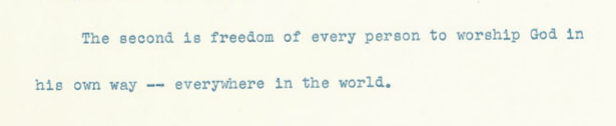
The first is freedom of speech and expression--everywhere in the world.
See Franklin D. Roosevelt, Annual Message to Congress on the State of the Union (Jan. 6, 1941), Nat’l Archives.
So simply expressed — seemingly the consequence of a tutelary inspiration to which Roosevelt was receptive.
Did we come through depression and war victorious, only to find ourselves under the feet of a senescent tyrant? While he fills the heads of hundreds of millions only with intrusive thoughts of himself, he denies many of those same people freedom of thought and expression.
Trump conditions press access on acquiescence and subservience. The Trump White House excluded Associated Press journalists from events after the AP continued to use “Gulf of Mexico” in its reporting. Here is Trumpism in full: you must speak and think as he speaks, however inane his words, descriptions, and thoughts.
Trump has attempted to limit — and often succeeded in limiting — which clients law firms represent, which causes they advance, and which outcomes they seek. In his executive order against Perkins Coie — the very drafting of which was a transgression against liberty — Trump ordered restrictions affecting Perkins Coie’s clearances, federal contracts, and access to government personnel and buildings. See Addressing Risks From Perkins Coie LLP, Exec. Order No. 14,230, 90 Fed. Reg. 11,781 (Mar. 11, 2025).
Here is our American president, who interferes in the American practice of law.
Trump's nativism, likewise, goes beyond the insatiable craving of his administration to pursue nonviolent immigrants as though they were savage animals. This alone, of course, would make Trump a threat to others and a stain on our history. Yet he goes further: Trump also uses immigration enforcement as a cudgel against free expression. In a ruling over the treatment of noncitizen students and faculty engaged in pro-Palestinian advocacy, a federal district court found that officials had pursued detention, deportation, and visa revocation to chill protected political speech. See Am. Ass’n of Univ. Professors v. Rubio, No. 25-10685, findings of fact and rulings of law (D. Mass. Sept. 30, 2025).
Where Roosevelt hoped for a world in which speech was protected everywhere, Trump silences America's voice in that world. He ordered the U.S. Agency for Global Media, which includes Voice of America, to reduce its functions and personnel to the minimum required by law. This order largely halted VOA operations; a district court later found the agency’s actions unlawful under administrative law. Ending broadcasts intended for audiences abroad is the very opposite of Roosevelt’s commitment to expression beyond our borders. Here, at home, Trump silences and stifles our own people's voices to those beyond our shores.
We need not travel abroad to encounter odious restrictions on free expression — they are imposed on us within our own borders.