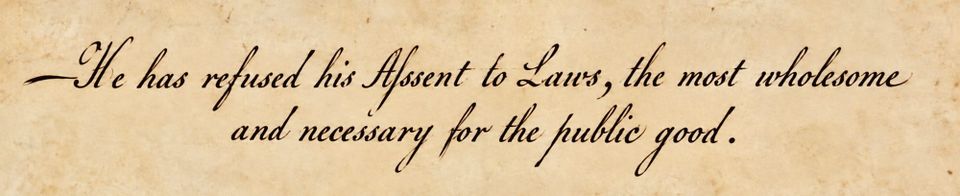
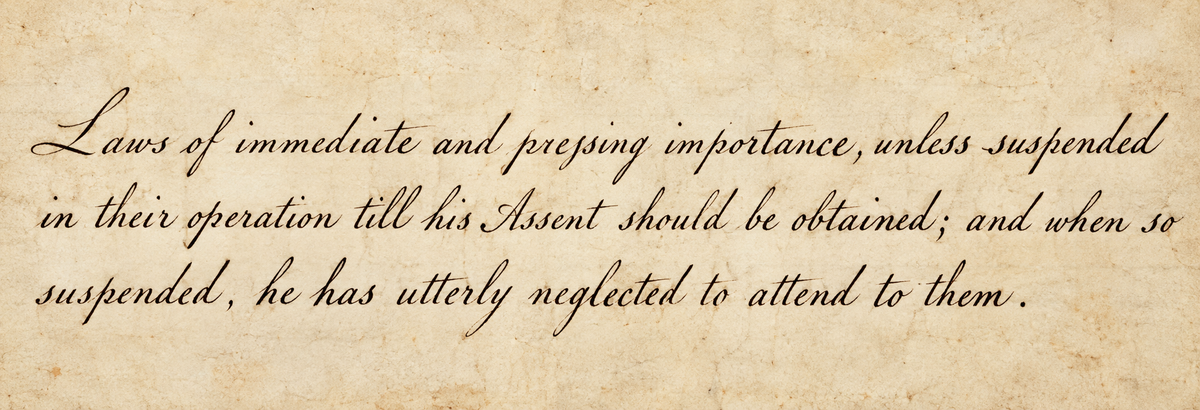
These Days Before the Vote: “Laws of immediate and pressing importance, unless suspended in their operation till his Assent should be obtained; and when so suspended, he has utterly neglected to attend to them.”
Whitewater, Wis. — Today’s entry continues These Days Before the Vote, a series addressing each day before the November election a principle or position on which the liberal democratic tradition rests.
Consider the Declaration’s charge against the British monarch that “He has forbidden his Governors to pass Laws of immediate and pressing importance, unless suspended in their operation till his Assent should be obtained; and when so suspended, he has utterly neglected to attend to them.”
While we’ve no royal governors, we have a lawfully established Department of Health and Human Services (HHS) and National Institutes of Health (NIH). Their work serves over three hundred thirty million Americans. While those Americans’ needs did not disappear after January 20, 2025, the grant reviews and awards in support of those needs did. On January 21, Acting HHS Secretary Dorothy Fink, claiming authority “at the direction of the new Administration,” issued a directive for the Immediate Pause on Issuing Documents and Public Communications. See Memorandum from Dorothy A. Fink, Acting Sec’y, U.S. Dep’t of Health & Hum. Servs., to Heads of Operating Divs. & Heads of Staff Divs., Immediate Pause on Issuing Documents and Public Communications—ACTION (Jan. 21, 2025).
The direction of the new Administration, by interrupting congressionally funded work, was a present-day version of centuries-ago royal obstruction. Legally required peer reviews depend on advance publication of meeting notices. The National Institutes of Health published no grant-review meeting notices between January 22 and March 3, 2025, thereby preventing reviews and awards that required new notices. The interruption of congressionally funded work obstructed necessary public measures through executive delay.
In an August 2025 determination, the Government Accountability Office (GAO) found that through these delays NIH violated the Impoundment Control Act. The administration had submitted no relevant special message to Congress, and HHS failed to justify the withholding as a permissible program delay. The GAO acknowledged that some delays might be lawful, while finding that these delays were not. See U.S. Gov’t Accountability Off., Department of Health and Human Services—National Institutes of Health—Application of Impoundment Control Act to Availability of Funds for Grants, B-337203 (Aug. 5, 2025).
A man who commands others to delay unlawfully necessary public work makes himself a king. A man who commands others to delay unlawfully that necessary work on the claim that he possibly knows the public good above all others makes himself a deluded king.